Apple Watch sleep score by age: what is good?
What counts as a good Apple Watch sleep score, how the 100 points are split, how much sleep you need at your age, and why deep sleep can read low.
By Roscoe Morris, co-founder of VitaOS · Published 28 October 2026
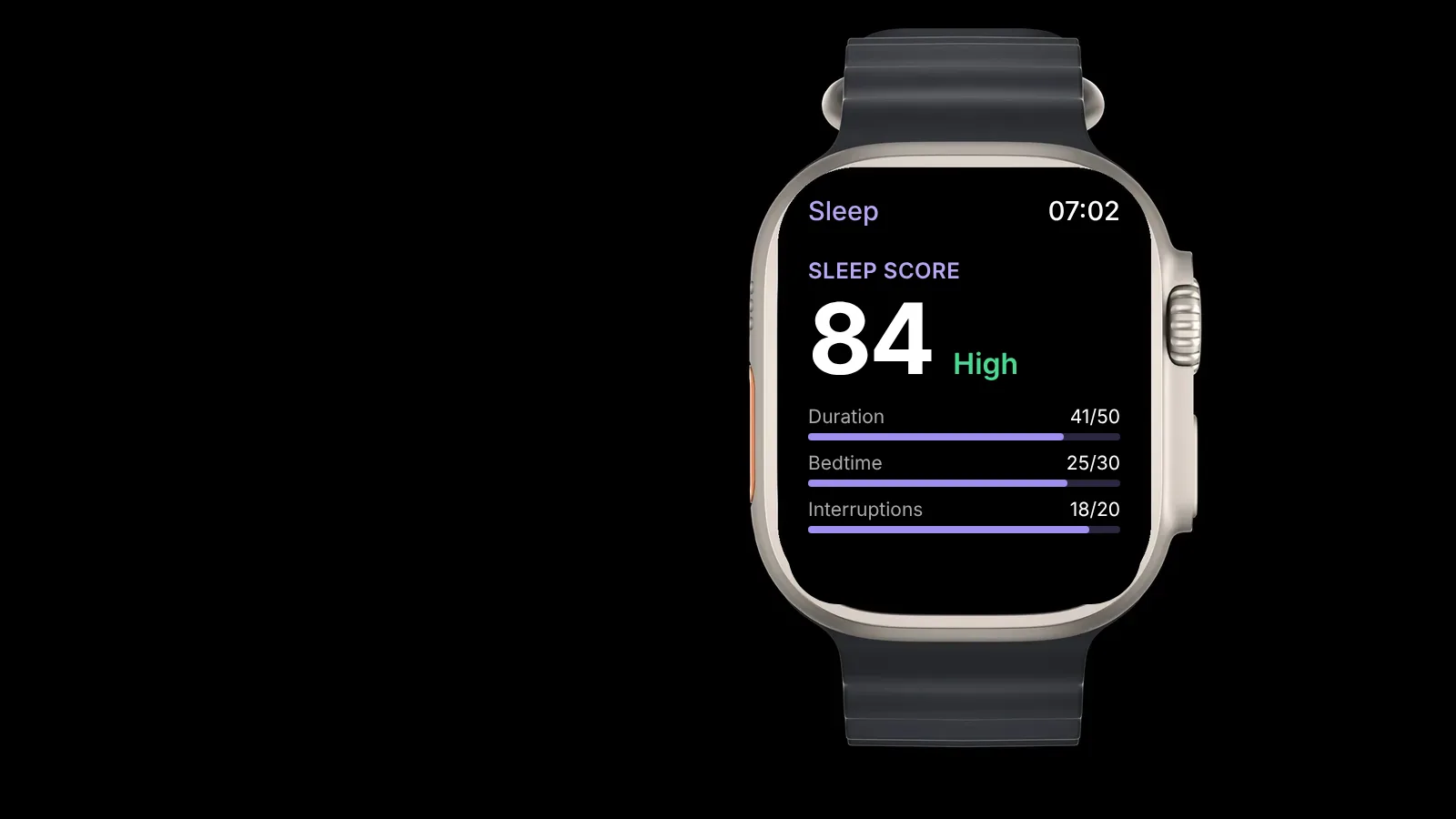
The short answer: Apple rates a sleep score of 81 to 95 as High and 96 or more as Very High. The score is out of 100: up to 50 points for how long you slept, 30 for falling asleep at a regular time and 20 for few interruptions, according to Apple. For adults, the NHS puts the usual need at 7 to 9 hours a night.
What is a good sleep score on Apple Watch?
Anything from 81 up is a good night by Apple's own labels. Apple splits the 0 to 100 score into five bands (Apple Support):
| Sleep score | Apple's rating |
|---|---|
| 96 to 100 | Very High |
| 81 to 95 | High |
| 61 to 80 | OK |
| 41 to 60 | Low |
| 0 to 40 | Very Low |
One night tells you little. A score in the 60s after a late dinner or a 5am flight is expected; a run of Low scores over a fortnight is worth looking into, starting with the three parts below.
How is the Apple Watch sleep score calculated?
Apple scores three things from the night before: sleep duration (up to 50 points), bedtime consistency (up to 30) and interruptions (up to 20). Bedtime consistency looks at when you fell asleep over the last 13 nights, and interruptions at how often you woke and how long you stayed awake (Apple Support).
Two things are missing from that list. Apple does not publish how many hours earn the full 50 points, and your sleep stages (Core, REM and Deep) are not one of the three parts, so a night with little deep sleep can still score High. To see the breakdown, open the Sleep app on the watch and tap the info button, or tap your score under Sleep in the Health app on your iPhone.
What is a good sleep score for my age?
Apple does not say it adjusts the score for age, but sleep itself changes. A 2019 meta-analysis of 169 sleep lab studies and 5,273 healthy adults found that with each decade, total sleep fell by about 10 minutes and time awake during the night rose by about 10 minutes. That trend chips at the duration and interruptions points as you get older.
| Age | Sleep advised | Sleep vs age 30 | Awake in the night vs age 30 |
|---|---|---|---|
| 40 | 7 to 9 hours | about 10 min less | about 10 min more |
| 50 | 7 to 9 hours | about 20 min less | about 20 min more |
| 60 | 7 to 9 hours | about 30 min less | about 30 min more |
| 70 | 7 to 8 hours | about 40 min less | about 40 min more |
Advised hours are from the National Sleep Foundation's expert panel (7 to 9 hours for adults, 7 to 8 from 65); the other two columns are the per-decade averages from the meta-analysis, rounded. So a score that slips a few points over the years can simply be age. Compare your score with your own usual run of nights, not with someone half your age.
Why is my deep sleep so low on Apple Watch?
Often because there is less of it to find as you get older, and because no wrist device measures it directly. A 2004 meta-analysis of 65 studies found the share of deep (slow-wave) sleep falls with age in adults. The 2019 meta-analysis, using newer scoring rules, found no significant change, so the size of the drop is still argued over.
Deep sleep also is not part of the Apple sleep score, and an expert panel for the National Sleep Foundation found little or no agreement that sleep stages are a good guide to sleep quality. The measures it did agree on were time to fall asleep, waking for more than 5 minutes, time awake in the night and the share of time in bed spent asleep. Watch those before the deep sleep bar.
Is the Apple Watch sleep score accurate?
Treat it as a trend, not a measurement. In a 2026 study against home polysomnography (the clinical sleep test) in healthy adults aged 18 to 45, Apple Watch Series 7 underestimated light sleep by about 74 minutes and overestimated REM by about 30 minutes, yet ranked best of the three wearables tested.
The authors conclude these devices suit tracking your own trends over time, not clinical-grade sleep measurement. That fits how the score works: it rests on when the watch thinks you fell asleep and woke, so the same errors repeat night after night, and a change in your score over weeks says more than any single number.
Why is my Apple Watch sleep score not showing?
Usually because the watch did not record enough of the night. Apple says Track Sleep with Apple Watch must be turned on, you need to wear the watch for at least an hour of sleep, and the battery should be at 30% or more at bedtime; a watch that runs flat records nothing (Apple Support). The score appears after you wake up.
Other checks: both iPhone and watch on the latest software, a sleep schedule set in the Health app, and a strap snug enough to stay in contact with your skin. Turning on Charging Reminders in the Watch app on your iPhone prompts you to charge before wind down.
How can I improve my Apple Watch sleep score?
Go to sleep at a similar time every night, including weekends. Bedtime consistency is worth 30 of the 100 points, and the NHS advises a regular routine because going to bed and getting up at similar times helps your body know when it is time to sleep.
For the other 70 points, the same NHS page suggests a calm wind-down, less caffeine late in the day, avoiding alcohol and nicotine for 1 to 2 hours before bed, and a quiet, dark, cool bedroom. Set your sleep schedule in the Health app to give you 7 to 9 hours in bed, since the duration points need the time to be there.
When should you see a GP about your sleep?
See a GP if changing your sleep habits has not helped, you have had trouble sleeping for months, or it is making daily life hard to cope with, says the NHS. A low score on its own is not a reason to worry; how you feel in the day matters more.
Also see a GP if your breathing stops and starts while you sleep, you make gasping, snorting or choking noises, or you always feel very tired during the day. These can be signs of sleep apnoea, and a partner who has noticed them can help by coming with you.
How VitaOS reads your sleep
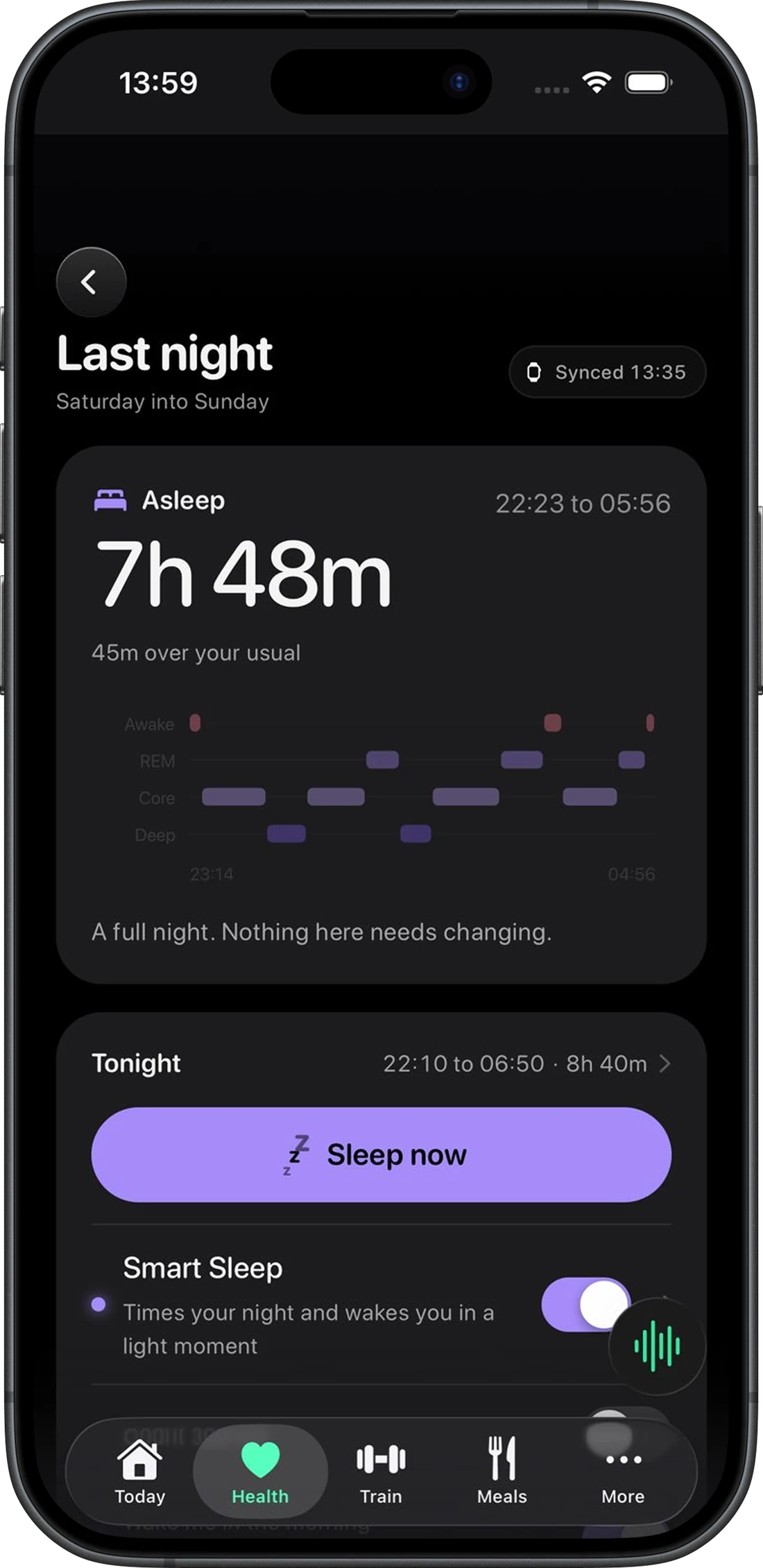
VitaOS reads your sleep stages, heart rate and HRV from your Apple Watch every night and compares them with your own usual range, so a run of bad nights shows up as a pattern, not just a feeling. The screen above shows a full night: 8 hours 6 minutes slept against 7 hours 52 minutes needed.
It then sets the day around the night: how hard to train, what to eat and when to go to bed. For the other overnight readings, see Apple Watch HRV by age and resting heart rate by age. See how VitaOS reads your recovery, or, if your sleep has got lighter in your 40s or 50s, what it does for women in midlife.
Sources
Apple. View your sleep score on Apple Watch. Apple Watch User Guide. And Track your sleep on Apple Watch and use Sleep on iPhone.
Boulos, M. I., Jairam, T., Kendzerska, T., and colleagues (2019). Normal polysomnography parameters in healthy adults: a systematic review and meta-analysis. The Lancet Respiratory Medicine, 7(6), 533 to 543.
Ohayon, M. M., Carskadon, M. A., Guilleminault, C., & Vitiello, M. V. (2004). Meta-analysis of quantitative sleep parameters from childhood to old age in healthy individuals. Sleep, 27(7), 1255 to 1273.
Hirshkowitz, M., Whiton, K., Albert, S. M., and colleagues (2015). National Sleep Foundation's sleep time duration recommendations: methodology and results summary. Sleep Health, 1(1), 40 to 43.
Ohayon, M., Wickwire, E. M., Hirshkowitz, M., and colleagues (2017). National Sleep Foundation's sleep quality recommendations: first report. Sleep Health, 3(1), 6 to 19.
Alhejaili, F., Alshumrani, R., Alamoudi, W., and colleagues (2026). Performance of three consumer sleep-tracking devices compared with actigraphy and polysomnography. Sleep Medicine.
NHS. Insomnia, Sleep apnoea and Every Mind Matters, How to fall asleep faster and sleep better.