Apple Watch resting heart rate by age: what is normal?
A typical wrist-tracker resting heart rate in your 50s is about 65 for men and 67 for women. Ranges by age and sex, accuracy, and what moves it.
By Roscoe Morris, co-founder of VitaOS · Published 22 October 2026
The short answer: a normal adult resting heart rate is usually 60 to 100 beats per minute (bpm), says the British Heart Foundation. Wrist trackers tend to show less: in two years of data from 92,457 adults, the average was 65 bpm, and about 64 to 65 for men and 67 for women in their 50s. Your own usual matters more than any chart.
What is a normal resting heart rate on Apple Watch for my age?
For most adults over 40, a wrist-measured resting heart rate between the low 50s and about 80 bpm is typical. The table comes from a 2020 PLOS ONE study (Quer and colleagues) of daily resting heart rate from Fitbit wrist trackers worn for at least 35 weeks by 92,457 US adults, the closest published match to how a smartwatch works it out.
| Age | Men: average | Women: average |
|---|---|---|
| 30 to 39 | about 63 bpm | about 67 bpm |
| 40 to 49 | about 64 to 65 bpm | about 67 to 68 bpm |
| 50 to 59 | about 64 to 65 bpm | about 67 bpm |
| 60 to 69 | about 63 bpm | about 66 bpm |
| 70 to 79 | about 61 bpm | about 64 bpm |
The averages are read from the study's age chart (Figure 3A), so treat them as approximate. Across all ages, 95% of men sat between 50 and 80 bpm and 95% of women between 53 and 82 bpm. Unlike HRV, resting heart rate does not simply fall with age: in this study the average rose until about 50, then drifted down.
What is a good resting heart rate for a 50 year old?
On a wrist tracker, the average at 50 is about 64 to 65 bpm for men and about 67 bpm for women (Quer 2020), with most healthy people between the low 50s and about 80. Women had a higher resting heart rate than men at every age, which the BHF puts down to women's hearts tending to be slightly smaller and pumping less blood per beat.
Around 50 is also where the study's averages peaked, so a reading a few beats higher than you had at 35 is not unusual. A rise above your own usual that lasts tells you more than how you compare with other people.
How does Apple Watch measure resting heart rate?
Apple Watch reads your pulse with an optical sensor on its back: green LEDs flash hundreds of times a second and light-sensitive photodiodes measure how much blood is flowing through your wrist, according to Apple. The sensor covers 30 to 210 bpm, and during your sleep schedule it can use infrared light instead.
Resting heart rate is one of the figures the Heart Rate app shows, alongside walking, workout and post-workout heart rate. Apple says a good fit helps the watch get consistent readings.
Is Apple Watch resting heart rate accurate?
Yes, it is one of the more reliable readings on the watch. In a 2024 study of 39 healthy adults wearing Apple Watch Series 9 or Ultra 2 for 14 days, resting heart rate was on average within 0.1 bpm of a Polar H10 chest strap, with a typical error of about 3.7 bpm (about 6%).
The same study found the watch's HRV readings far less precise, which is why Apple Watch HRV is best read as a weekly trend. Resting heart rate can be trusted from day to day, but a single high morning still means less than a week of them.
Where do you find resting heart rate on Apple Watch?
On your iPhone, open the Health app, tap Browse, then Heart, then Resting Heart Rate. You can switch between day, week, month and year views; the week and month averages are the most useful for spotting a real change.
On the watch, open the Heart Rate app to see today's figures, including your resting rate.
Why is my resting heart rate so low?
Usually because you are fit, or because of a medicine. The BHF says a resting rate below 60 bpm is too slow for most people but can be normal for people who are very fit, and that medicines such as beta blockers slow the heart. A low number with no symptoms is not, on its own, a problem.
If a slow rate comes with fainting or tiredness, the BHF advises booking a GP appointment. Apple Watch can also warn you when your heart rate stays below a level you choose: in the Apple Watch app on your iPhone, tap My Watch, Heart, then Low Heart Rate.
Why has my resting heart rate gone up?
Most rises are short-term: illness, poor sleep, alcohol, stress or the time of year. The BHF lists infections, fever, dehydration, anxiety and stress among causes of a faster heart rate, and alcohol and smoking among habits that change it. In the Quer study, the average was about 2 bpm higher in early January than at the end of July, and lowest in people who slept 7 to 7.5 hours a night.
Short swings are common: 20% of people in that study had at least one week where their resting heart rate moved by 10 bpm or more. A rise that lasts for weeks, or comes with symptoms, is worth raising with your GP.
Can you lower your resting heart rate after 40?
Yes, mainly with endurance exercise. A 2018 meta-analysis of 191 studies (Reimers and colleagues) found endurance training lowered resting heart rate by about 2.7 to 5.8 bpm compared with not exercising, depending on sex, and yoga by about 5 bpm. An earlier meta-analysis in older adults, cited in the same review, found endurance training lowered it by about 6 bpm.
Strength training had no significant effect overall, though it lowered resting heart rate by about 2 bpm in women. Expect change over months, not weeks. For where to start, see improving your VO2 max over 50 and strength training after 40.
Why does resting heart rate matter as you get older?
A higher resting heart rate is linked with a higher risk of dying early, though a link is not proof of cause. In a 2016 meta-analysis of 46 studies and 1.2 million people, each 10 bpm higher was associated with a 9% higher risk of death from any cause, and a rate above 80 bpm with a 45% higher risk than the lowest group.
Fitness, sleep and medicines all move the number, so it is most useful tracked against yourself over months rather than judged from one reading.
When should you see a GP about your heart rate?
The BHF advises making a GP appointment if your resting heart rate is above 100 bpm, or if it is below 60 bpm and you have symptoms such as fainting or tiredness. The NHS advises seeing a GP about palpitations that keep coming back or last longer than a few minutes.
Call 999 or go to A&E if palpitations do not go away or come with chest pain, shortness of breath or fainting. A watch reading is not a diagnosis; if something worries you, speak to your GP.
How VitaOS reads your resting heart rate
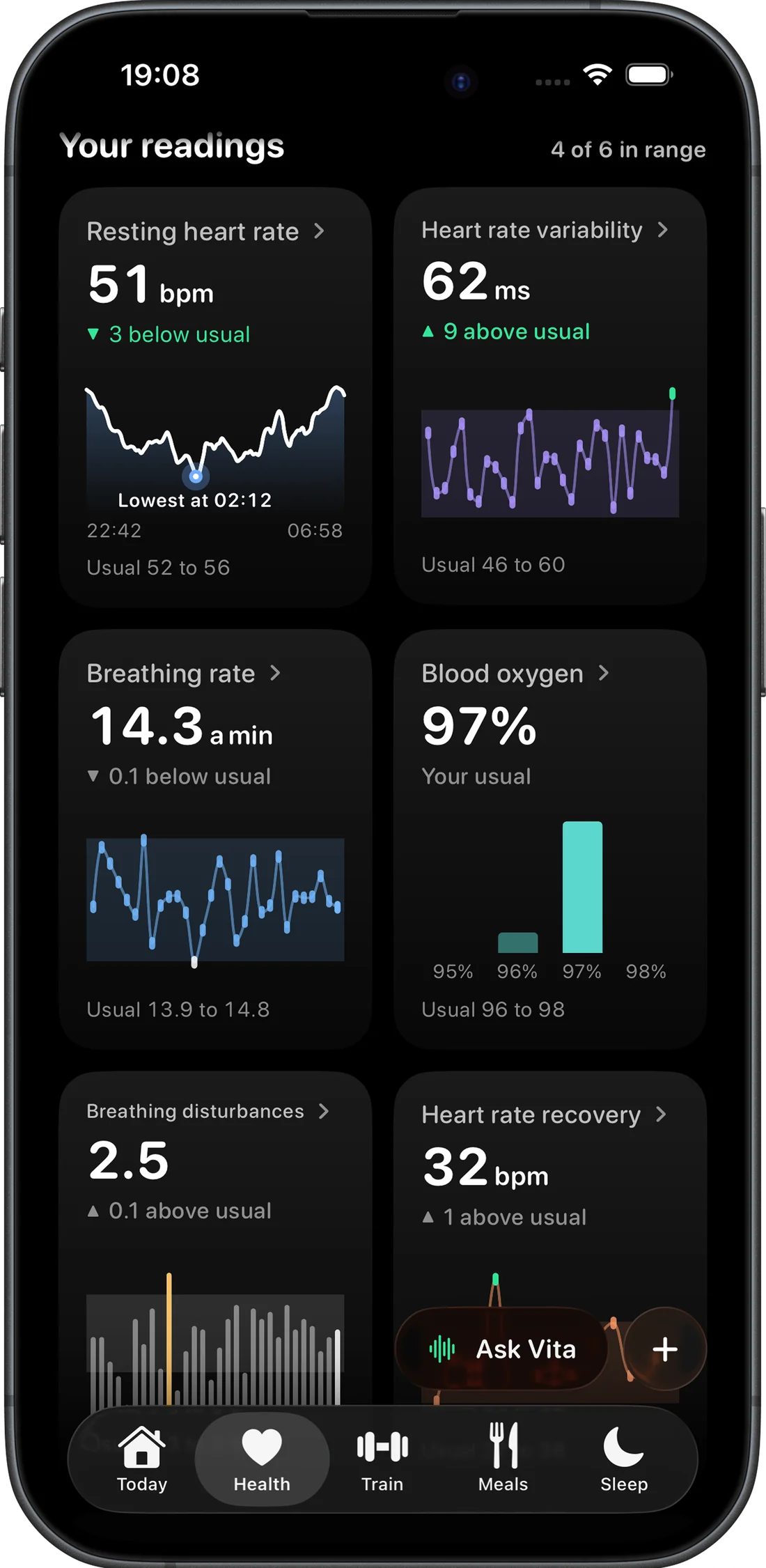
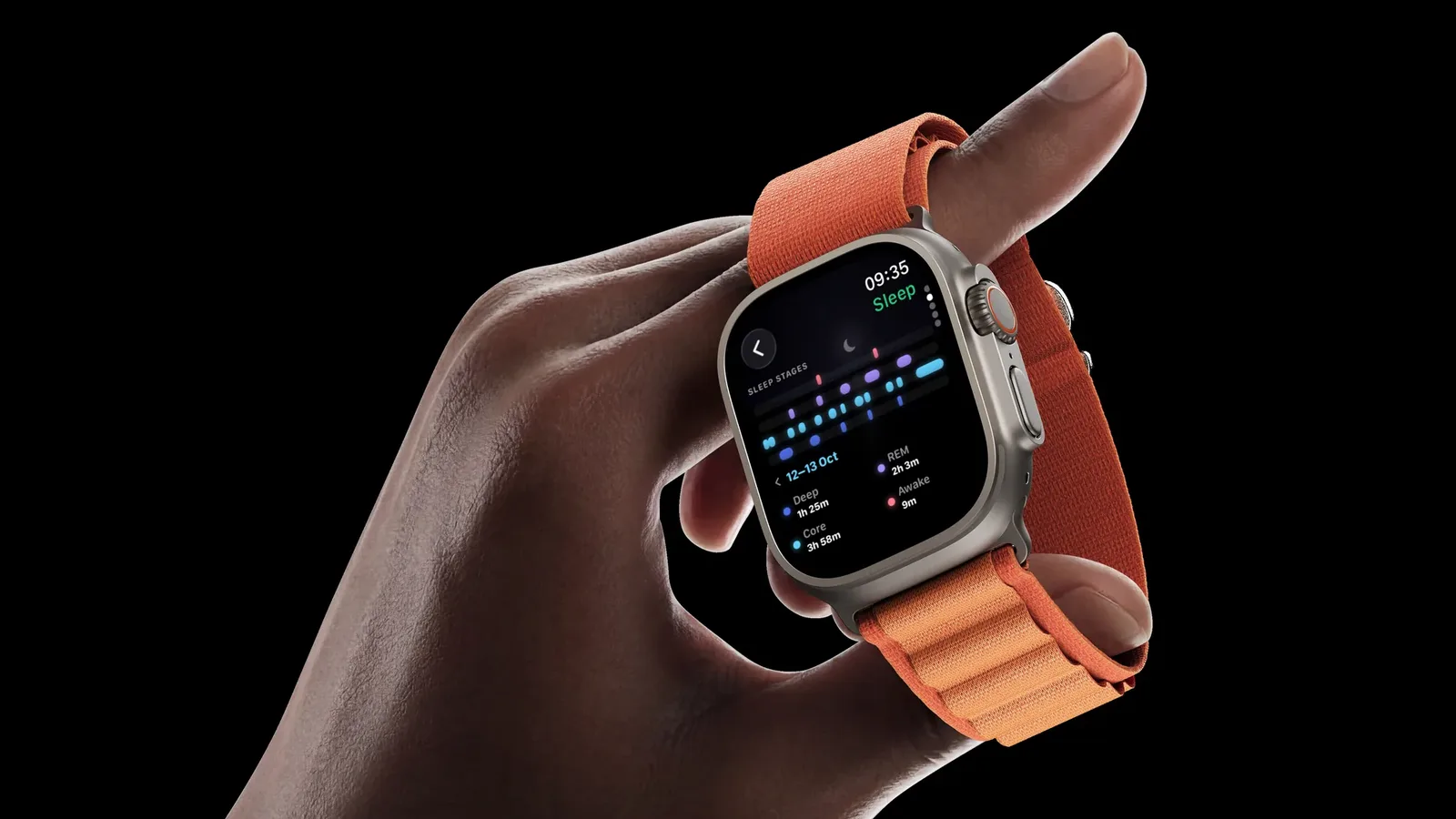
Every night VitaOS reads your resting heart rate, HRV and sleep from your Apple Watch and compares them with your own normal, not an age chart. The screen above shows 51 bpm against a usual range of 52 to 56, with the night's lowest point at 02:12.
Training is then set from your heart rate and recovery: harder when you have recovered, lighter when you have not. Resting heart rate also feeds your fitness age, alongside VO2 max. See how VitaOS reads your recovery, or how it sets your training.
Sources
Quer, G., Gouda, P., Galarnyk, M., Topol, E. J., & Steinhubl, S. R. (2020). Inter- and intraindividual variability in daily resting heart rate and its associations with age, sex, sleep, BMI, and time of year: retrospective, longitudinal cohort study of 92,457 adults. PLOS ONE, 15(2), e0227709.
British Heart Foundation. Heart rate: what's normal and how to check it. Updated August 2026.
O'Grady, B., Lambe, R., Baldwin, M., Acheson, T., & Doherty, C. (2024). The validity of Apple Watch Series 9 and Ultra 2 for serial measurements of heart rate variability and resting heart rate. Sensors, 24(19), 6220.
Reimers, A. K., Knapp, G., & Reimers, C. D. (2018). Effects of exercise on the resting heart rate: a systematic review and meta-analysis of interventional studies. Journal of Clinical Medicine, 7(12), 503.
Zhang, D., Shen, X., & Qi, X. (2016). Resting heart rate and all-cause and cardiovascular mortality in the general population: a meta-analysis. CMAJ, 188(3), E53 to E63.
Apple. Monitor your heart rate with Apple Watch and Heart health notifications on your Apple Watch.
NHS. Heart palpitations.