Apple Watch HRV by age: what is a good number?
A typical Apple Watch HRV at 45 to 54 is about 22 to 51 ms, and it falls with age. Ranges by age and sex, accuracy, and what moves the number.
By Roscoe Morris, co-founder of VitaOS · Published 20 October 2026
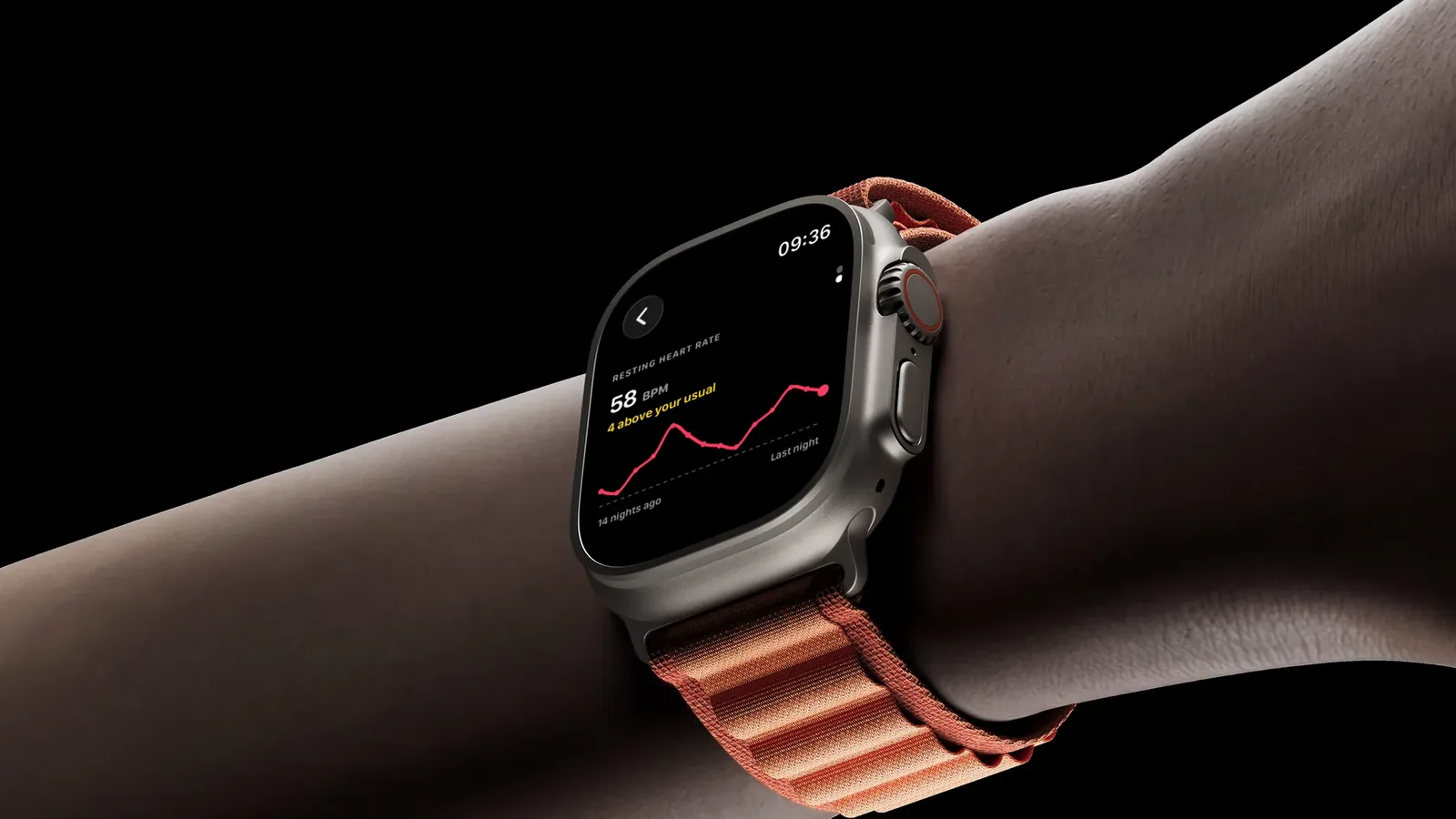
The short answer: Apple Watch shows HRV as SDNN in milliseconds, and the typical number falls with age. In a study of 1,906 healthy German adults, average SDNN was about 50 ms at 25 to 34, 37 ms at 45 to 54 and 28 to 30 ms at 65 to 74. Your own usual matters more than any chart.
What is a good HRV on Apple Watch for my age?
For most people over 45, an Apple Watch HRV somewhere between the high teens and the low 50s is typical. The table below comes from 5-minute ECG readings in 1,906 healthy adults (Voss and colleagues, 2015), measured as SDNN, the same measure Apple uses. The range is the average plus or minus one standard deviation, where roughly two in three people sat.
| Age | Men: average (typical range) | Women: average (typical range) |
|---|---|---|
| 25 to 34 | 50 ms (29 to 71) | 49 ms (30 to 68) |
| 35 to 44 | 45 ms (28 to 61) | 45 ms (25 to 66) |
| 45 to 54 | 37 ms (22 to 51) | 37 ms (23 to 51) |
| 55 to 64 | 33 ms (18 to 48) | 31 ms (18 to 43) |
| 65 to 74 | 30 ms (16 to 43) | 28 ms (16 to 40) |
Two cautions. The study used a chest ECG while lying still, and the watch uses an optical sensor on the wrist at different times of day, so treat the table as a rough guide. And a reading above the band is not automatically better: what tells you most is how today compares with your own usual.
What is a good HRV for a 50 year old?
Around 37 ms on average, with most healthy people between about 22 and 51 ms. That is the 45 to 54 band in the Voss study, and men and women were almost identical at this age (36.8 and 36.9 ms). By 55 to 64 the average was 33 ms for men and 31 ms for women.
HRV falls fastest between your mid-30s and mid-60s. In the same study, the drop from 35 to 44 to 45 to 54 was the biggest step for both sexes, so a lower number at 50 than you had at 35 is expected, not a warning sign.
Is 26 a bad HRV? Is 37 low?
Not on their own. At 55 to 64, 26 ms sits inside the typical range for both men and women, and 37 ms is close to the average for anyone aged 45 to 54 (Voss 2015). A single number tells you little; a drop well below your own usual that lasts several days tells you more.
Apple Watch readings also jump around from one reading to the next, so look at the weekly average in the Health app rather than one figure.
How does Apple Watch measure HRV?
Apple Watch records heart rate variability as SDNN: the standard deviation of the time between normal heartbeats, in milliseconds, according to Apple's HealthKit documentation. The watch takes readings in the background several times a day and night, and also when you do a Breathe session in the Mindfulness app.
Many other wearables report a different measure called RMSSD, which gives lower numbers for the same heart: at 45 to 54, average RMSSD in the Voss study was 23 to 26 ms against 37 ms for SDNN. Do not compare an Apple Watch figure with a chart made for another brand.
Is the HRV on Apple Watch accurate?
Its heart rate is very accurate, but single HRV readings are only moderately so. In a 2025 study of 78 adults aged 20 to 75, Apple Watch Series 6 heart rate was within about 1% of a lab ECG at rest, while its HRV readings were off by about 31% on average. A 2024 study of Series 9 and Ultra 2 found an average error of about 20 ms (29%) against a chest strap.
Both studies found agreement was best at rest. In practice that means trends over a week or more are useful, and any one reading should be taken lightly.
Where do you find HRV on Apple Watch?
On your iPhone, open the Health app, tap Browse, then Heart, then Heart Rate Variability. You can switch between day, week, month and year views; the week and month averages are the most useful.
Why is my HRV going down?
The two causes with the clearest evidence are age and alcohol. HRV falls steadily through middle age (Voss 2015). And in a Finnish study of 4,098 working adults (average age 45), even low alcohol intake lowered overnight HRV-based recovery, by 9 percentage points, rising to 39 points after high intake.
The alcohol effect was seen in men and women, and in active and inactive people alike. If your HRV dips the night after a drink, that is the pattern the study found.
Can you raise your HRV after 40?
Regular exercise training tends to raise resting HRV. A meta-analysis of 13 studies found training increased the part of HRV linked to rest and recovery, though the effect was smaller in older people. Cutting back on alcohol helps the overnight number too (Pietilä 2018).
Expect slow change over months, not days, and judge it against your own baseline rather than the age table. For training planned around your recovery, see strength training after 40.
When should you see a GP about heart readings?
HRV on its own is not used to diagnose anything, so a low number is not a reason to panic. The NHS advises seeing a GP if you get palpitations that keep coming back, last longer than a few minutes, or you have a heart condition or a family history of heart problems.
Call 999 or go to A&E if palpitations come with chest pain, shortness of breath or fainting. If something on your watch worries you, speak to your GP rather than relying on the reading.
How VitaOS reads your HRV
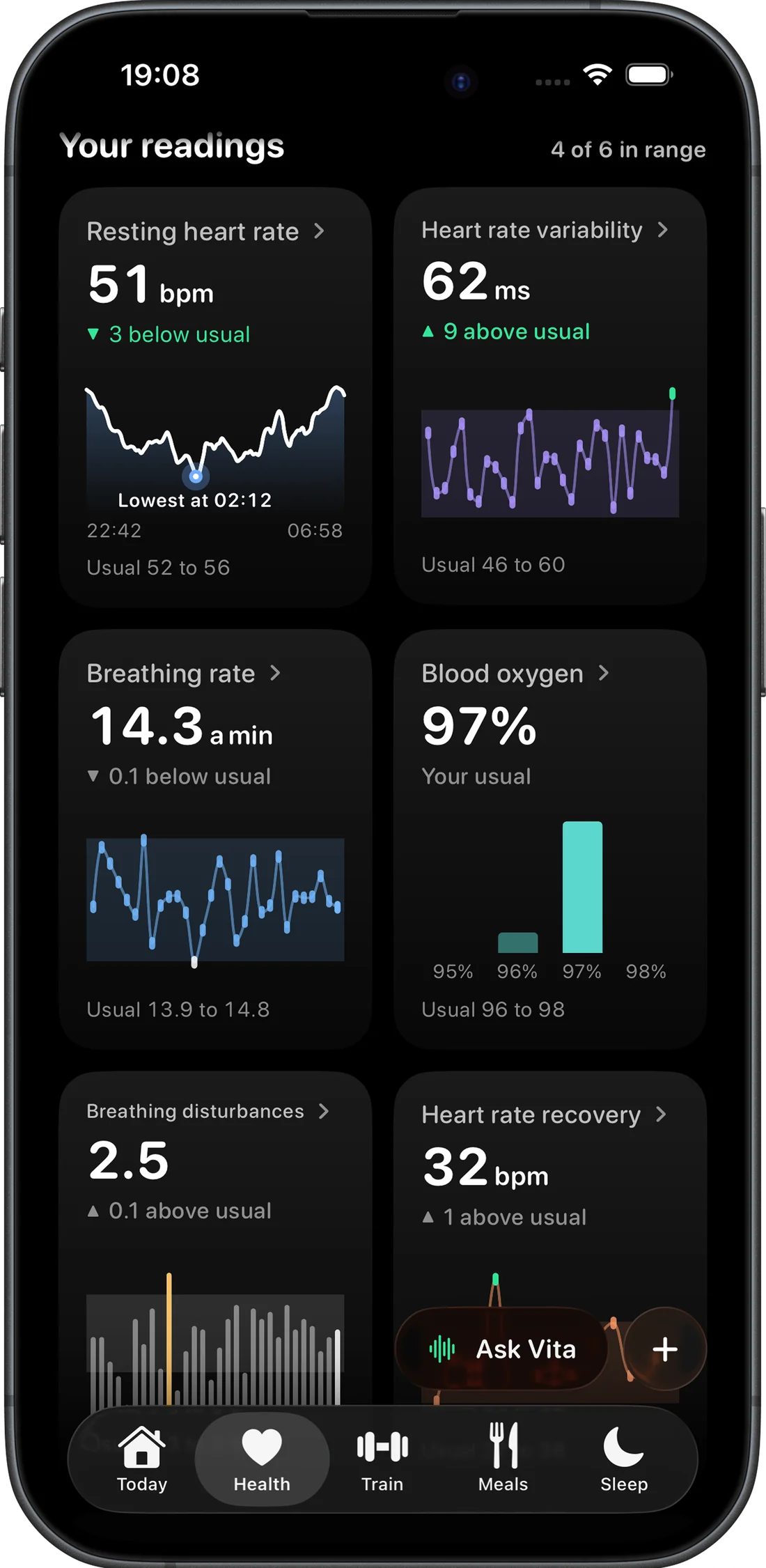
VitaOS reads your HRV overnight from your Apple Watch, along with resting heart rate, breathing and blood oxygen, and compares each one with your own usual range rather than an age chart. The screen above shows a reading of 62 ms against a usual range of 46 to 60.
When you are above your usual, that day's workout can go up a level; when you are below it, the plan is set lighter. See how VitaOS reads your recovery, or how it sets your training. For the other readings it uses, see Apple Watch resting heart rate by age and Apple Watch VO2 max by age.
Sources
Voss, A., Schroeder, R., Heitmann, A., Peters, A., & Perz, S. (2015). Short-term heart rate variability: influence of gender and age in healthy subjects. PLOS ONE, 10(3), e0118308.
Apple. HealthKit: heartRateVariabilitySDNN.
Bonneval, L., Wing, D., Sharp, S., and colleagues (2025). Validity of heart rate variability measured with Apple Watch Series 6 compared to laboratory measures. Sensors, 25(8), 2380.
O'Grady, B., Lambe, R., Baldwin, M., Acheson, T., & Doherty, C. (2024). The validity of Apple Watch Series 9 and Ultra 2 for serial measurements of heart rate variability and resting heart rate. Sensors, 24(19), 6220.
Pietilä, J., Helander, E., Korhonen, I., and colleagues (2018). Acute effect of alcohol intake on cardiovascular autonomic regulation during the first hours of sleep in a large real-world sample of Finnish employees. JMIR Mental Health, 5(1), e23.
Sandercock, G. R., Bromley, P. D., & Brodie, D. A. (2005). Effects of exercise on heart rate variability: inferences from meta-analysis. Medicine and Science in Sports and Exercise, 37(3), 433 to 439.
This article is general information, not medical advice. VitaOS is a wellness app and does not diagnose or treat any condition. If you have a health concern, speak to your GP.